Announcement

Collapse
No announcement yet.

Look at Joseph's WORDS, not the pictures.

Collapse
X
 
  • Filter
  • Time
  • Show
Clear All
new posts

  • #46
    Originally posted by LA Ute View Post
    OK, I'll drop back in. What is it about "how it came about" that bothers you? I really am interested. From all I can tell we know almost nothing about how the text of the B of A came to be.
    As I understand it, I think we have a pretty good idea of how we got the text of the BOA. There is a notebook showing the BOA text adjacent to the same symbols from the scrolls. For each symbol, there is about a paragraph of BOA text. The text is in the handwriting of one of Joseph's scribes. I think it's been called Egyptian Alphabet and Grammar, or something like that.

    It seems like the evidence is pretty clear that Joseph got the BOA from the surviving scrolls, and he was sure that he translated the heiroglyphics correctly.
    "...you pointy-headed autopsy nerd. Do you think it's possible for you to post without using words like "hilarious," "absurd," "canard," and "truther"? Your bare assertions do not make it so. Maybe your reasoning is too stunted and your vocabulary is too limited to go without these epithets."
    "You are an intemperate, unscientific poster who makes light of very serious matters.”
    - SeattleUte

    Comment


    • #47
      Tangent inspired by this thread:

      Does it bug anyone else that the church sits on top of a pile of Mormon heritage documents and artifacts with seeming no intention of ever making these things available to us? I mean obviously the church owns the stuff, so it is their right to do with it whatever they want, but what about their ethical responsibility? It is OUR heritage. Technology has made it possible to digitally archive the church's artifacts. Moreover, the church is in a position to undertake the process of digitally archiving its holdings in a professional way. Members of the church are interested in their heritage, and should have access to this stuff. I think that it is an ethical lapse that the church holds part of this heritage captive.

      Comment


      • #48
        Originally posted by Northwestcoug View Post
        As I understand it, I think we have a pretty good idea of how we got the text of the BOA. There is a notebook showing the BOA text adjacent to the same symbols from the scrolls. For each symbol, there is about a paragraph of BOA text. The text is in the handwriting of one of Joseph's scribes. I think it's been called Egyptian Alphabet and Grammar, or something like that.

        It seems like the evidence is pretty clear that Joseph got the BOA from the surviving scrolls, and he was sure that he translated the heiroglyphics correctly.
        Once again, I'm no expert but it's my understanding that there was only one eyewitness to the transcription (Warren Parrish, who apparently left the church later) and that the points you suggest as accepted are in fact pretty controversial. See the quote in my first post below:

        http://cougaruteforum.com/showpost.p...2&postcount=16
        “There is a great deal of difference in believing something still, and believing it again.”
        ― W.H. Auden


        "God made the angels to show His splendour - as He made animals for innocence and plants for their simplicity. But men and women He made to serve Him wittily, in the tangle of their minds."
        -- Robert Bolt, A Man for All Seasons


        "It is only with the heart that one can see rightly; what is essential is invisible to the eye."
        --Antoine de Saint-Exupery

        Comment


        • #49
          Originally posted by LA Ute View Post
          Once again, I'm no expert but it's my understanding that there was only one eyewitness to the transcription (Warren Parrish, who apparently left the church later) and that the points you suggest as accepted are in fact pretty controversial. See the quote in my first post below:

          http://cougaruteforum.com/showpost.p...2&postcount=16
          I think it's Warren Parrish's handwriting in the notebook. If that's the case, I don't think there's much controversy. Unless we have strong evidence to the contrary (which I don't think we do), we should take him at his word.

          I'll see if I can dig up a reference.
          "...you pointy-headed autopsy nerd. Do you think it's possible for you to post without using words like "hilarious," "absurd," "canard," and "truther"? Your bare assertions do not make it so. Maybe your reasoning is too stunted and your vocabulary is too limited to go without these epithets."
          "You are an intemperate, unscientific poster who makes light of very serious matters.”
          - SeattleUte

          Comment


          • #50
            Quote:

            There is a set of documents that the church has always had in its possession commonly referred to as the "Egyptian Alphabet and Grammar" by Joseph Smith. Most of us remember hearing a little bit about it growing up in the church but not really knowing what it was. It was only briefly and rarely mentioned in church. With the discovery of the missing papyri in 1966, critics claim that these documents show a definite link between the papyri and the actual text of the Book of Abraham.

            The manuscript is in the handwriting of William W. Phelps and Warren Parrish, scribes to Joseph Smith, Jr. It is a bound book with handwriting on 34 pages with about 184 blank pages remaining throughout the book. There are characters in a left hand column with English explanations to the right. Original in LDS archives. There are 4 pages in Joseph Smith's handwriting.

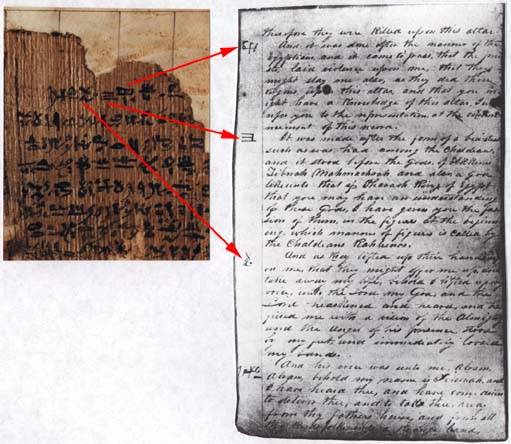
            The following diagram on the left shows a copy of the small sensen portion of the rediscovered papyri. This portion was originally directly attached to facsimile 1 before it was cut off and sealed behind glass by Joseph and company to preserve the papyri. It was to the left of the papyri (Egyptian reads right to left). The following diagram on the right is from the Egyptian Alphabet & Grammar by Joseph Smith. It has the exact same symbols, in order, from the small sensen papyri and next to it is the apparent translation as it appears in the Book of Abraham that we have as scripture today.


            This does appear to show which portions of the papyri the Book of Abraham came from. It certainly makes sense that the piece of papyri directly next to facsimile 1 would be referring to facsimile 1. Also the fact that every symbol from this same piece of papyri is written on the Egyptian Book of Alphabet and Grammar in precisely the same order with the BOA verses next to each one of the symbols is pretty compelling evidence not to be ignored.

            Taken from the 'Joseph's Egyptian Alphabet and Grammar' section of:
            http://mormonthink.com/book-of-abraham-issues.htm#text
            "...you pointy-headed autopsy nerd. Do you think it's possible for you to post without using words like "hilarious," "absurd," "canard," and "truther"? Your bare assertions do not make it so. Maybe your reasoning is too stunted and your vocabulary is too limited to go without these epithets."
            "You are an intemperate, unscientific poster who makes light of very serious matters.”
            - SeattleUte

            Comment


            • #51
              Originally posted by Northwestcoug View Post
              Quote:

              There is a set of documents that the church has always had in its possession commonly referred to as the "Egyptian Alphabet and Grammar" by Joseph Smith. Most of us remember hearing a little bit about it growing up in the church but not really knowing what it was. It was only briefly and rarely mentioned in church. With the discovery of the missing papyri in 1966, critics claim that these documents show a definite link between the papyri and the actual text of the Book of Abraham.

              The manuscript is in the handwriting of William W. Phelps and Warren Parrish, scribes to Joseph Smith, Jr. It is a bound book with handwriting on 34 pages with about 184 blank pages remaining throughout the book. There are characters in a left hand column with English explanations to the right. Original in LDS archives. There are 4 pages in Joseph Smith's handwriting.

              The following diagram on the left shows a copy of the small sensen portion of the rediscovered papyri. This portion was originally directly attached to facsimile 1 before it was cut off and sealed behind glass by Joseph and company to preserve the papyri. It was to the left of the papyri (Egyptian reads right to left). The following diagram on the right is from the Egyptian Alphabet & Grammar by Joseph Smith. It has the exact same symbols, in order, from the small sensen papyri and next to it is the apparent translation as it appears in the Book of Abraham that we have as scripture today.


              This does appear to show which portions of the papyri the Book of Abraham came from. It certainly makes sense that the piece of papyri directly next to facsimile 1 would be referring to facsimile 1. Also the fact that every symbol from this same piece of papyri is written on the Egyptian Book of Alphabet and Grammar in precisely the same order with the BOA verses next to each one of the symbols is pretty compelling evidence not to be ignored.

              Taken from the 'Joseph's Egyptian Alphabet and Grammar' section of:
              http://mormonthink.com/book-of-abraham-issues.htm#text
              Interesting, thanks. Now we are very deep into detail, beyond my own knowledge. I looked at mormonthink.com, and it appears to be a site for critics of the church. What's the position of the other side - people like Nibley, Gee and the FARMS crowd?
              “There is a great deal of difference in believing something still, and believing it again.”
              ― W.H. Auden


              "God made the angels to show His splendour - as He made animals for innocence and plants for their simplicity. But men and women He made to serve Him wittily, in the tangle of their minds."
              -- Robert Bolt, A Man for All Seasons


              "It is only with the heart that one can see rightly; what is essential is invisible to the eye."
              --Antoine de Saint-Exupery

              Comment


              • #52
                Originally posted by LA Ute View Post
                Interesting, thanks. Now we are very deep into detail, beyond my own knowledge. I looked at mormonthink.com, and it appears to be a site for critics of the church. What's the position of the other side - people like Nibley, Gee and the FARMS crowd?
                Nibley said that the attempt at the Egyptian Alphabet and Grammar was "not fruitful" and quickly abandoned. And that it was a project in which many men participated.

                http://maxwellinstitute.byu.edu/publ...scripts/?id=48

                Q. What are the specific charges?

                A. (1) We are asked to see Joseph Smith diligently composing an "Alphabet" and a "Grammar" of the Egyptian language, (2) by employing which he works out the translation of the Book of Abraham from certain Egyptian characters in his possession. (3) The source of those characters, and Egyptian writing called the Book of Breathings, suddenly surfaces in 1967, and it does not contain anything suggesting the Book of Abraham. (4) Therefore the Book of Abraham is a fraud.

                Q. Isn't that evidence enough to convict?

                A. Only if the charges are true. But none of them will hold water. Let us consider them in order.

                1. Joseph Smith never produced an Alphabet or Grammar of the Egyptian language. What was repeatedly and falsely put forth as "Joseph Smith's Original Alphabet and Grammar" was an enterprise in which a number of men engaged. The leader of the project was W.W. Phelps and by far the greatest part of the writing is in his hand. Phelps had an ambitious plan for methodically working out an Egyptian Grammar and Alphabet, but it quickly became apparent that the approach was not a fruitful one, and it was at once dropped for good.

                Q. But wasn't Smith in on it?

                A. He was indeed, sharing his ideas with the others, for both works were purely speculative and exploratory.

                Q. How do you know that?

                A. Because of the six men participating, each makes his own contribution; no two of their interpretations are identical. The whole thing is quite fluid. The men are admittedly exploring and interpreting. Most importantly, the project never got off the ground. The most ambitious version of the grammar, that of Phelps, ground to a halt after a single page, and his equally ambitious alphabet was given up after a page and a half, before the second letter was completed.

                Q. Then what is behind it?

                A. Obviously they were doing what they explicitly stated they were doing, i.e. trying to produce an Alphabet and Grammar of the Egyptian language—nothing was said about a project of translating the Book of Abraham. Their interest in such an enterprise was perfectly legitimate and understandable. They had priceless Egyptian manuscripts in their possession and were irresistibly drawn to search for clues. The decipherment of Egyptian was a problem which excited many at the time, and the School of the Prophets had a legitimate and honest interest in the study of Biblical and related languages. At the time Phelps made independent attempts at translating parts of the Bible; Oliver Cowdery, one of the group, had eagerly sought some years before to translate "the engravings of old records, which are ancient" (D&C 8:1). The instructions given Cowdery in the matter are extremely important: he is not to expect the power to translate to come to him as a gift, but must first "study it out in your mind," and only "then you must ask me if it be right" with no guarantee of acceptance (D&C 9:7). This is the process we see going on in the Egyptian exercises.

                Q. The critics say that the "Grammar" proves that Joseph Smith did not know Egyptian.

                A. Nobody ever said he did; his translations were "given to him" as the expression went, by direct revelation. If he did know it, why would he be sweating over a grammar and alphabet?

                Q. Then Joseph Smith did write an Egyptian Grammar?

                A. He did not. He would very much have liked to, for the subject intrigued him to the end of his life, when he suggested the possibility of such an undertaking in the future.

                Comment


                • #53
                  Originally posted by LA Ute View Post
                  Interesting, thanks. Now we are very deep into detail, beyond my own knowledge. I looked at mormonthink.com, and it appears to be a site for critics of the church. What's the position of the other side - people like Nibley, Gee and the FARMS crowd?
                  The problem w the apologists is that they aren't real truth seekers. They open with a certain premise that the church is what it purports to be, the try to make the model--whatever it may be--fit.

                  Comment


                  • #54
                    Originally posted by Viking View Post
                    The problem w the apologists is that they aren't real truth seekers. They open with a certain premise that the church is what it purports to be, the try to make the model--whatever it may be--fit.
                    Recognizing that "apologist" is a pejorative term here, what you've said is not the classical definition of the term.

                    Signed,

                    Local Defender of the Faith
                    “There is a great deal of difference in believing something still, and believing it again.”
                    ― W.H. Auden


                    "God made the angels to show His splendour - as He made animals for innocence and plants for their simplicity. But men and women He made to serve Him wittily, in the tangle of their minds."
                    -- Robert Bolt, A Man for All Seasons


                    "It is only with the heart that one can see rightly; what is essential is invisible to the eye."
                    --Antoine de Saint-Exupery

                    Comment


                    • #55
                      Originally posted by LA Ute View Post
                      Recognizing that "apologist" is a pejorative term here, what you've said is not the classical definition of the term.

                      Signed,

                      Local Defender of the Faith
                      I never use it as a pejorative and always think its odd when people get defensive about that word.

                      Comment


                      • #56
                        Originally posted by jay santos View Post
                        I never use it as a pejorative and always think its odd when people get defensive about that word.
                        I was responding to Viking, who was using it that way. And calling people who disagree with you defensive is just message board game-playing. You're a much more sincere person than that.

                        EDIT: I think most here understand what apologetics really means but sometimes I'm not so sure.
                        Last edited by LA Ute; 07-24-2011, 10:59 PM.
                        “There is a great deal of difference in believing something still, and believing it again.”
                        ― W.H. Auden


                        "God made the angels to show His splendour - as He made animals for innocence and plants for their simplicity. But men and women He made to serve Him wittily, in the tangle of their minds."
                        -- Robert Bolt, A Man for All Seasons


                        "It is only with the heart that one can see rightly; what is essential is invisible to the eye."
                        --Antoine de Saint-Exupery

                        Comment


                        • #57
                          Originally posted by LA Ute View Post
                          Interesting, thanks. Now we are very deep into detail, beyond my own knowledge. I looked at mormonthink.com, and it appears to be a site for critics of the church. What's the position of the other side - people like Nibley, Gee and the FARMS crowd?
                          In general, mormonthink is critical with most sensitive issues of the church. It is edited by mostly members, with a few ex members contributing. They always give 2 sides to each controversy; the apologists' and the outside critics. They then summarize with their viewpoint (which is usually closer to the critics than the apologists). However, no matter what side you're on, they analyze each issue extensively and give multiple references. If you read anything on their site, you won't miss any critical information.

                          Originally posted by CardiacCoug View Post
                          Nibley said that the attempt at the Egyptian Alphabet and Grammar was "not fruitful" and quickly abandoned. And that it was a project in which many men participated.

                          http://maxwellinstitute.byu.edu/publ...scripts/?id=48
                          I remember reading Nibley's faux courtroom arguments for a few controversies, including this one. He had a flair for entertaining language, but in this case I think he's stretching credulity. I really believe there is not much left to the apologists' argument with the BOA. Most of it is just not defensible. Time to fold and move on to another controversy.
                          "...you pointy-headed autopsy nerd. Do you think it's possible for you to post without using words like "hilarious," "absurd," "canard," and "truther"? Your bare assertions do not make it so. Maybe your reasoning is too stunted and your vocabulary is too limited to go without these epithets."
                          "You are an intemperate, unscientific poster who makes light of very serious matters.”
                          - SeattleUte

                          Comment


                          • #58
                            Originally posted by Northwestcoug View Post
                            In general, mormonthink is critical with most sensitive issues of the church. It is edited by mostly members, with a few ex members contributing. They always give 2 sides to each controversy; the apologists' and the outside critics. They then summarize with their viewpoint (which is usually closer to the critics than the apologists). However, no matter what side you're on, they analyze each issue extensively and give multiple references. If you read anything on their site, you won't miss any critical information.

                            I remember reading Nibley's faux courtroom arguments for a few controversies, including this one. He had a flair for entertaining language, but in this case I think he's stretching credulity. I really believe there is not much left to the apologists' argument with the BOA. Most of it is just not defensible. Time to fold and move on to another controversy.
                            “There is a great deal of difference in believing something still, and believing it again.”
                            ― W.H. Auden


                            "God made the angels to show His splendour - as He made animals for innocence and plants for their simplicity. But men and women He made to serve Him wittily, in the tangle of their minds."
                            -- Robert Bolt, A Man for All Seasons


                            "It is only with the heart that one can see rightly; what is essential is invisible to the eye."
                            --Antoine de Saint-Exupery

                            Comment


                            • #59
                              Originally posted by LA Ute View Post
                              I was responding to Viking, who was using it that way. And calling people who disagree with you defensive is just message board game-playing. You're a much more sincere person than that.

                              EDIT: I think most here understand what apologetics really means but sometimes I'm not so sure.
                              Yeah and I probably use it the exact same way Viking did, but not as a pejorative. It maybe be a semantics thing, but i think the point is important.

                              I can say things like apologists are not truth seekers. And I may be stereotyping, I may be unfair, I maybe inciting. But not labeling with a pejorative.

                              Just like I can say Ute fans are jerks. You can say what you want about the opinion, but it's not using Ute fan as a pejorative.

                              Comment


                              • #60
                                Originally posted by Northwestcoug View Post
                                In general, mormonthink is critical with most sensitive issues of the church. It is edited by mostly members, with a few ex members contributing. They always give 2 sides to each controversy; the apologists' and the outside critics. They then summarize with their viewpoint (which is usually closer to the critics than the apologists). However, no matter what side you're on, they analyze each issue extensively and give multiple references. If you read anything on their site, you won't miss any critical information.
                                I think you're being a little too generous to Mormonthink from a critical perspective. Of the "anti-Mormon" sites they're definitely on the respectful side of things and they attempt to at least appear to be balanced. But it's definitely not a balanced site.

                                Comment

                                Working...
                                X