Announcement

Collapse
No announcement yet.

Obamacare cost...

Collapse
X
 
  • Filter
  • Time
  • Show
Clear All
new posts

  • Originally posted by Uncle Ted View Post
    Kff.org? That isn't an exchange website. Where do I buy this insurance?


    Edit: As I posted above the numbers came from someone's post on the government's (HealthCare.gov's) facebook page. (see https://www.facebook.com/Healthcare.gov ). There are lots of examples of people with the same issue. If you actually have a source to where one can buy health insurance for less money then you should post here and on the government's facebook page for all those asking the same question.
    You can run the same numbers on the exchange website. The info you have just isn't true. It's verifiably false. Not that facts seem to matter.

    Most of those complaining that I'm hearing are people with employer care and they are comparing what they pay now versus what they would pay on the exchange. That's a bad comparison for several reasons. First, their employer almost certainly subsidizes their insurance so what the employee pays is not the actual cost. Second, the cost in the group plan is based in the demographics of those who are covered by the group plan which could be more favorable than the nation as a whole.

    Comment


    • Originally posted by calicoug View Post
      You can run the same numbers on the exchange website. The info you have just isn't true. It's verifiably false. Not that facts seem to matter.
      Ah, no I can't. I have been trying to do that since Wednesday. This is as far as I get...

      HealthCare.jpg

      and

      SystemUnavailable.jpg

      If you can actually verify as false then show me a screen shot otherwise.


      Originally posted by calicoug View Post
      Most of those complaining that I'm hearing are people with employer care and they are comparing what they pay now versus what they would pay on the exchange. That's a bad comparison for several reasons. First, their employer almost certainly subsidizes their insurance so what the employee pays is not the actual cost. Second, the cost in the group plan is based in the demographics of those who are covered by the group plan which could be more favorable than the nation as a whole.
      From what I have read folks that have employer insurance are going to be paying more or are being forced into the exchanges because they are part-time and their employer is cutting their costs by dropping their benefit.

      Obama promised that we would be saving $2,500 per family. Where exactly is that savings?
      "If there is one thing I am, it's always right." -Ted Nugent.
      "I honestly believe saying someone is a smart lawyer is damning with faint praise. The smartest people become engineers and scientists." -SU.
      "Yet I still see wisdom in that which Uncle Ted posts." -creek.
      GIVE 'EM HELL, BRIGHAM!

      Comment


      • Originally posted by calicoug View Post
        You can run the same numbers on the exchange website. The info you have just isn't true. It's verifiably false. Not that facts seem to matter.

        Most of those complaining that I'm hearing are people with employer care and they are comparing what they pay now versus what they would pay on the exchange. That's a bad comparison for several reasons. First, their employer almost certainly subsidizes their insurance so what the employee pays is not the actual cost. Second, the cost in the group plan is based in the demographics of those who are covered by the group plan which could be more favorable than the nation as a whole.
        are you still denying obamacare is increasing insurance costs?

        Comment


        • Originally posted by calicoug View Post
          You know you can run the numbers through the calculator to verify what you wrote, right?

          http://kff.org/interactive/subsidy-c...hild-tobacco=0

          Plug in $32k per year in a single member household. You don't get a $10k bill after subsidies.

          I tried this website, which goes down occasionally but will pop back up and seems relatively robust. I entered data for a 30 year old single mom with two young kids, non-smoking, living in UT without an employer plan, making $12,000 per year. Below the poverty line, right?

          KFF.jpg

          Can someone help me understand this? My hypothetical mom lives way below the poverty line, but my health plan is $6,097, or more than 50% of my income? First it says I get it for free (0% max I would have to pay), but then it says I have to pay $6,097 for the premium, and then it says I would receive a governmental tax credit of $0. So which is it?

          I ran this hypothetical to ask a larger question: if the subsidies are tax credits, then how can anyone in poverty pay for their premiums up front, and wait to get their tax credits at the end of the year? I am sincerely interested in knowing the answer to this, as you MUST pay premiums before using the insurance, which could be thousands of dollars of outlay before getting a tax credit.

          Comment


          • I don't see where it says 0% max you would have to pay.

            It looks like if UT doesn't espand Medicaid, then your hypothetical mom is sol, which seems contrary to my understanding of how the system is supposed to work.
            "I think it was King Benjamin who said 'you sorry ass shitbags who have no skills that the market values also have an obligation to have the attitude that if one day you do in fact win the PowerBall Lottery that you will then impart of your substance to those without.'"
            - Goatnapper'96

            Comment


            • Originally posted by Katy Lied View Post
              I tried this website, which goes down occasionally but will pop back up and seems relatively robust. I entered data for a 30 year old single mom with two young kids, non-smoking, living in UT without an employer plan, making $12,000 per year. Below the poverty line, right?

              [ATTACH]3109[/ATTACH]

              Can someone help me understand this? My hypothetical mom lives way below the poverty line, but my health plan is $6,097, or more than 50% of my income? First it says I get it for free (0% max I would have to pay), but then it says I have to pay $6,097 for the premium, and then it says I would receive a governmental tax credit of $0. So which is it?

              I ran this hypothetical to ask a larger question: if the subsidies are tax credits, then how can anyone in poverty pay for their premiums up front, and wait to get their tax credits at the end of the year? I am sincerely interested in knowing the answer to this, as you MUST pay premiums before using the insurance, which could be thousands of dollars of outlay before getting a tax credit.
              Maybe they can adjust the deductions on their W-4 or whatever so less taxes are withheld from their paycheck?

              Of course, the real question is if your single mom will be getting a tax credit...

              http://www.nytimes.com/2013/10/03/he...pagewanted=all
              Millions of Poor Are Left Uncovered by Health Law

              A sweeping national effort to extend health coverage to millions of Americans will leave out two-thirds of the poor blacks and single mothers and more than half of the low-wage workers who do not have insurance, the very kinds of people that the program was intended to help, according to an analysis of census data by The New York Times.
              [...]
              People shopping for insurance on the health exchanges are already discovering this bitter twist.


              “How can somebody in poverty not be eligible for subsidies?” an unemployed health care worker in Virginia asked through tears. The woman, who identified herself only as Robin L. because she does not want potential employers to know she is down on her luck, thought she had run into a computer problem when she went online Tuesday and learned she would not qualify.
              [...]
              So are these people that can't afford health insurance still subject to the "Obamacare tax" for not having health insurance?
              "If there is one thing I am, it's always right." -Ted Nugent.
              "I honestly believe saying someone is a smart lawyer is damning with faint praise. The smartest people become engineers and scientists." -SU.
              "Yet I still see wisdom in that which Uncle Ted posts." -creek.
              GIVE 'EM HELL, BRIGHAM!

              Comment


              • Originally posted by Uncle Ted View Post
                Maybe they can adjust the deductions on their W-4 or whatever so less taxes are withheld from their paycheck?

                Of course, the real question is if your single mom will be getting a tax credit...

                http://www.nytimes.com/2013/10/03/he...pagewanted=all


                So are these people that can't afford health insurance still subject to the "Obamacare tax" for not having health insurance?
                The article says they are not subject to the "tax."
                "I think it was King Benjamin who said 'you sorry ass shitbags who have no skills that the market values also have an obligation to have the attitude that if one day you do in fact win the PowerBall Lottery that you will then impart of your substance to those without.'"
                - Goatnapper'96

                Comment


                • Originally posted by Pelado View Post
                  The article says they are not subject to the "tax."
                  http://blogs.findlaw.com/law_and_lif...s-mandate.html
                  τὸν ἥλιον ἀνατέλλοντα πλείονες ἢ δυόμενον προσκυνοῦσιν

                  Comment


                  • Originally posted by Katy Lied View Post
                    I tried this website, which goes down occasionally but will pop back up and seems relatively robust. I entered data for a 30 year old single mom with two young kids, non-smoking, living in UT without an employer plan, making $12,000 per year. Below the poverty line, right?

                    [ATTACH]3109[/ATTACH]

                    Can someone help me understand this? My hypothetical mom lives way below the poverty line, but my health plan is $6,097, or more than 50% of my income? First it says I get it for free (0% max I would have to pay), but then it says I have to pay $6,097 for the premium, and then it says I would receive a governmental tax credit of $0. So which is it?

                    I ran this hypothetical to ask a larger question: if the subsidies are tax credits, then how can anyone in poverty pay for their premiums up front, and wait to get their tax credits at the end of the year? I am sincerely interested in knowing the answer to this, as you MUST pay premiums before using the insurance, which could be thousands of dollars of outlay before getting a tax credit.
                    This person is below the poverty line and therefore qualifies for Medicaid. However, it looks like your state is one of the states that has refused to expand Medicaid leaving this person screwed. The only fix is for the state to expand Medicaid. Let's hope they do.

                    Comment


                    • Originally posted by calicoug View Post
                      This person is below the poverty line and therefore qualifies for Medicaid. However, it looks like your state is one of the states that has refused to expand Medicaid leaving this person screwed. The only fix is for the state to expand Medicaid. Let's hope they do.
                      This person could move to California or some other debt-ridden state that has expanded medicaid.

                      Bad Medicaid Program Gets Worse Under ObamaCare

                      by Merrill Matthews

                      Medicaid is arguably the worst health insurance program in the country, and ObamaCare did nothing to fix its many problems.

                      That's one reason why several states have decided to reject the legislation's requirement to expand an out-of-control program to an estimated 16 million more Americans.

                      Medicaid is actually three different programs. It provides health insurance for low-income children, pregnant women and some adults; it is the primary source of coverage for the disabled; and it covers certain costs for poor seniors, including nursing home care and the premiums and out-of-pocket costs not covered by Medicare.

                      While low-income children, pregnant women and some adults account for 75% of total beneficiaries, they only spend 35% of Medicaid funds.

                      The disabled, by contrast, are 15% of the Medicaid population but account for 43% of expenditures — and their number has been exploding during President Obama's first term.

                      Growing costs for the disabled and nursing home populations were making Medicaid financially unsustainable for states even before ObamaCare passed.

                      And the legislation only increases those costs.

                      With respect to Medicaid's basic health insurance coverage, expansion proponents claim that hospitals will now be getting paid (via Medicaid) for services they had been providing for free.

                      A Democrat's Solution

                      However, Medicaid underpays hospitals for care, about 66% on average of what private health insurance would pay, according to the Centers for Medicare and Medicaid Services' (CMS) Office of the Actuary. And that percentage will decline.


                      Our calculations, which are in line with other studies, suggest that low Medicaid and Medicare reimbursement rates lead to about $78 billion being shifted to private insurance.

                      Many hospitals were able to cover some of their uncompensated-care costs because the federal government provides them with subsidies. But ObamaCare phases out those subsidies, leaving private insurance as the only target for cost shifting.

                      However, the Department of Health and Human Services is tracking premiums and harassing insurers that want more than a 10% annual increase, which could limit the impact of Medicaid costs shifting.

                      One former state Medicaid director tells us the uncertainty caused by the expanded Medicaid coverage, the decline in the subsidies, and the need to cost shift is already inflating health care costs.

                      As a result, states and counties may be compelled to funnel more taxpayer money to hospitals to make up the Medicaid shortfall. And states may not have the money.

                      Indeed, there are already news stories pointing out that several states are years behind in reimbursing hospitals for Medicaid expenses. The expansion will only make that problem worse.

                      Given the growing costs, it is not only reasonable but advisable for states to reject Medicaid expansion.

                      But that doesn't mean states can't address the needs of the low-income uninsured. One solution is to try what former Tennessee Gov. Phil Bredesen, a Democrat, did seven years ago.

                      In 2006 Tennessee created CoverTN, which allowed those without access to full employer coverage to get a limited-benefit policy that provided a maximum of $25,000 coverage a year.

                      The policy initially cost $150 a month, which was split equally by the state, employer and employee. Doctors' visits cost a $15 co-pay, and a mostly generic prescription drug plan was included.

                      Won't Cooperate

                      Of course, states could tweak several elements of such a plan to suit their needs and budgets, but Bredesen considered the program a great success, providing coverage to thousands of low-income workers.

                      States could also consider a high-deductible plan (e.g., $1,500), again with a $25,000 maximum payout.

                      Then the state could make a deposit, say $800, to each beneficiary's Health Savings Account, which would be used for smaller and routine expenditures.

                      While these are two examples, health insurers, working with the states, could come up with a range of innovative, low-cost plans. Indiana Gov. Mike Pence, for example, wants to build on its HSA option known as Healthy Indiana.

                      Had the Department of Health and Human Services (HHS) been willing to give states the flexibility to try such options — flexibility that many states have been demanding — conflicts might have been resolved early on. But HHS has made it clear it's their way or no way.
                      HHS's intransigence shouldn't stop the opt-out states from experimenting with affordable expansion ideas.

                      And better reimbursements could improve access to treatment and potentially lower costs by allowing individuals to avoid emergency rooms and inpatient stays.

                      Health insurance for the poor doesn't have to be poor insurance. And yet that's exactly what Medicaid is.

                      Obama refused to try new and innovative ways to cover the low-income populations. Maybe the opt-out states can.

                      Matthews is a resident scholar with the Institute for Policy Innovation in Dallas, Texas. Litow is a retired actuary and past chairman of the Social Insurance Public Finance Section of the Society of Actuaries.
                      http://news.investors.com/ibd-editor...-obamacare.htm
                      "If there is one thing I am, it's always right." -Ted Nugent.
                      "I honestly believe saying someone is a smart lawyer is damning with faint praise. The smartest people become engineers and scientists." -SU.
                      "Yet I still see wisdom in that which Uncle Ted posts." -creek.
                      GIVE 'EM HELL, BRIGHAM!

                      Comment


                      • Originally posted by Uncle Ted View Post
                        This person could move to California or some other debt-ridden state that has expanded medicaid.


                        http://news.investors.com/ibd-editor...-obamacare.htm
                        You won't get any argument from me (or anyone reasonable) that there are many issues with Medicaid. In no way does that mean it is reasonable for a state to refuse to expand Medicaid unless they have an alternative to ensure people like the one in our example aren't screwed. Most aren't doing that. Furthermore, the federal government has been quote flexible in allowing states to prepare their own plan which would satisfy the Medicaid expansion requirements. It isn't like refusing expansion is the only choice. Even if it is the only path pursued by several states under Republican control.

                        Comment


                        • Originally posted by calicoug View Post
                          You won't get any argument from me (or anyone reasonable) that there are many issues with Medicaid. In no way does that mean it is reasonable for a state to refuse to expand Medicaid unless they have an alternative to ensure people like the one in our example aren't screwed. Most aren't doing that. Furthermore, the federal government has been quote flexible in allowing states to prepare their own plan which would satisfy the Medicaid expansion requirements. It isn't like refusing expansion is the only choice. Even if it is the only path pursued by several states under Republican control.
                          Why would a state throw fuel on a "fiscal time time bomb"?

                          ObamaCare: The great Medicaid expansion

                          Federal officials are trumpeting the high “demand” that ObamaCare’s health insurance exchanges are experiencing, but their celebration is misguided.


                          What’s the point of the ObamaCare health insurance exchanges if the end result is to dump the majority of Americans covered under ObamaCare into Medicaid?


                          The truth is that more than three-quarters of the newly insured next year will be enrolled in Medicaid. In states that have expanded their Medicaid eligibility under ObamaCare, all individuals and families under age 65 that have incomes up to 138 percent of the poverty level will be automatically enrolled in Medicaid. All others who would be otherwise uninsured (and do not have employer-sponsored that is both “qualified” and “affordable”) may participate in the exchange.


                          The Medicaid program is a fiscal time bomb in which patients routinely face obstacles to obtaining care in the program. In Illinois, where reimbursements are well below the national average, for example, about one-third of physicians do not accept Medicaid patients. Nationally, 30 percent of physicians are not accepting Medicaid patients. Frankly, you don’t need state exchanges, employer mandates, individual mandates and the long list of costly ObamaCare provisions to throw people onto the Medicaid rolls.


                          James Taranto of The Wall Street Journal highlights a case of someone being thrown into the Medicaid rolls:


                          “Meet Brendan Mahoney, the young man who is saving ObamaCare. He's 30 years old, a third-year law student at the University of Connecticut. He's actually been insured for the past three years--in 2011 and 2012 through a $2,400-a-year school-sponsored health plan, and this year through "a high-deductible, low-premium plan that cost about $39 a month through a UnitedHealthcare subsidiary."


                          But he wanted to see what ObamaCare had to offer.


                          “So, how much of a premium is strapping young Brendan Mahoney paying to help make ObamaCare work? Oops. The Courant reports that Mahoney ‘said that by filling out the application online, he discovered he was eligible for Medicaid. So, beginning next year, he won't pay any premium at all.’”


                          Back in 2010, the Congressional Budget Office predicted that about 45 percent of the newly covered Americans under ObamaCare would be put into Medicaid and the Children’s Health Insurance Program in 2014. Today, the prediction is a whopping 78 percent. In addition, the federal government revised down its projected number of those who would be newly insured under ObamaCare from 22 million down to 11 million.


                          Even though they are “insured,” Medicaid patients routinely face barriers to access. This is especially true in Illinois where the program’s reimbursements are well below the national average, payments arrive late and many doctors are no longer accepting Medicaid patients.


                          Taranto concludes by saying, “So the great success story of ObamaCare's first day is the transformation of a future lawyer who was already paying for insurance into a welfare case.” Alas, that will likely be the legacy of the entire enterprise.
                          http://illinoispolicy.org/blog/blog....cleSource=6407
                          "If there is one thing I am, it's always right." -Ted Nugent.
                          "I honestly believe saying someone is a smart lawyer is damning with faint praise. The smartest people become engineers and scientists." -SU.
                          "Yet I still see wisdom in that which Uncle Ted posts." -creek.
                          GIVE 'EM HELL, BRIGHAM!

                          Comment


                          • Meet Cindy Vinson and Tom Waschura, two Californians exceedingly proud of their votes for Obama.

                            http://www.mercurynews.com/nation-wo...osers-bay-area

                            Here's what these two supporters of Obamacare have to say about their support and their thoughts after they received correspondence from their insurance carriers last week regarding premium increases:

                            But people with no pre-existing conditions like Vinson, a 60-year-old retired teacher, and Waschura, a 52-year-old self-employed engineer, are making up the difference.

                            "I was laughing at Boehner -- until the mail came today," Waschura said, referring to House Speaker John Boehner, who is leading the Republican charge to defund Obamacare.

                            "I really don't like the Republican tactics, but at least now I can understand why they are so pissed about this. When you take $10,000 out of my family's pocket each year, that's otherwise disposable income or retirement savings that will not be going into our local economy."

                            Both Vinson and Waschura have adjusted gross incomes greater than four times the federal poverty level -- the cutoff for a tax credit. And while both said they anticipated their rates would go up, they didn't realize they would rise so much.

                            "Of course, I want people to have health care," Vinson said. "I just didn't realize I would be the one who was going to pay for it personally."
                            Seriously, WTF? Who the hell do you think was going to pay for it?
                            Part of it is based on academic grounds. Among major conferences, the Pac-10 is the best academically, largely because of Stanford, Cal and UCLA. “Colorado is on a par with Oregon,” he said. “Utah isn’t even in the picture.”

                            Comment


                            • Originally posted by Color Me Badd Fan View Post
                              Seriously, WTF? Who the hell do you think was going to pay for it?
                              One of the grandest benefits of the enlightenment was the realization that our moral sense must be based on the welfare of living individuals, not on their immortal souls. Honest and passionate folks can strongly disagree regarding spiritual matters, so it's imperative that we not allow such considerations to infringe on the real happiness of real people.

                              Woot

                              I believe religion has much inherent good and has born many good fruits.
                              SU

                              Comment


                              • Originally posted by snowcat View Post
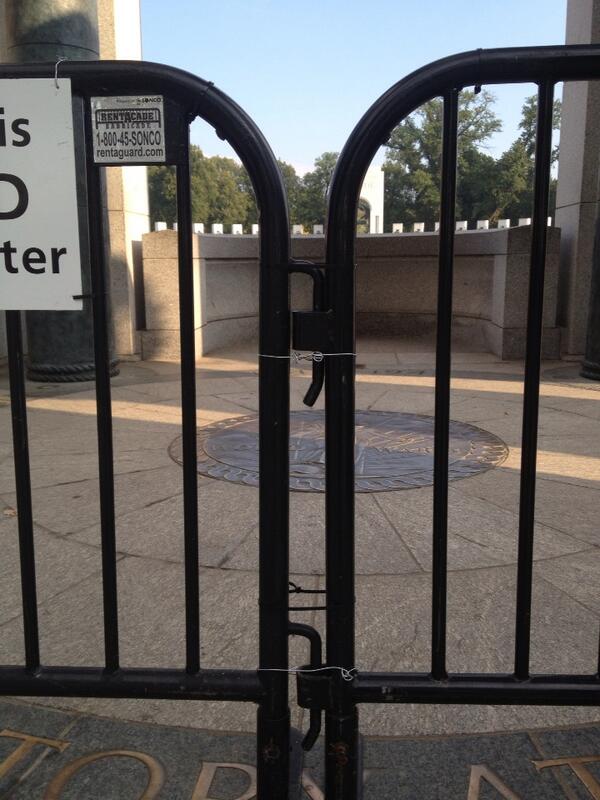
                                The WW II barrycades are now wired together:


                                Meanwhile at the WW I memorial:
                                WWII Vets....hell no you can't visit your memorial.....a pro amnesty protest, why hell yes, march on our national mall!

                                http://washingtonexaminer.com/park-s...rticle/2536908

                                Comment

                                Working...
                                X