Announcement

Collapse
No announcement yet.

Crash at Reno Air Races

Collapse
X
 
  • Filter
  • Time
  • Show
Clear All
new posts

  • #16
    Originally posted by NorthwestUteFan View Post
    You can choose to be offended if you desire. I didn't see your post until I posted my own, no offense intended.
    I was just kidding.

    The plane is 'highly modified', but it isn't highly modernized. It would still have the original linkage. The tail wheel slamming open in the turn is, as you suggest, highy unlikely. But if the trim tab ripped off and initiated the rapid, hard, upward pull it is possible for the wheel to slam downward.

    Also remember this is a 70+ year old plane and metal fatigue in the linkage could have been a factor.

    After Gary Levitz' crash I spoke with one of the plane's builders. He had suggested to the design engineers that they reinforce the aft fuselage to counter torsion. The P-51 apparently was somewhat weak in torsion, and he feared swapping a different set of wings and stab onto the existing fuse would load the fuse in an untested manner.

    Unfortunately no non-WWII planes have been competitive in the races, so they continue to fly 65-70 year old planes and designs.
    I recall the photos of Levitz' plane that you posted. That was a very radical change (the lear wings). I am not surpriesed it would cause torsion problems. Btw, and this is from memory (will it surprise you that I built lots of scale models when I was a kid) but the wings on that plane dont look stock to me. They look clipped and tipped. Is that true?

    While we both agree it would be unlikely the tail wheel goes down, there it is. So something happened. Either way a tragedy.

    I love those old planes, but stuff breaks on these old birds.
    PLesa excuse the tpyos.

    Comment


    • #17
      It had stock wings, but he chopped five feet off each side.

      And only the best amongst us built airplanes as young boys.

      Comment


      • #18
        Not to be crass, but is there any chance that the image without Levitz, where the rear wheel is extended, has been photoshopped? I ask for a few reasons:

        1. It is an unusual angle for a photograph of a plane in the air. It is almost a perfect profile. Where was the photographer who took this?

        2. Why is there no motion blur on the prop? Notice the motion blur on the prop in the other photos. Even at a high shutter speed, one would expect to get SOME motion blur on the prop.

        If the image was photoshopped, that would explain the angle of the shot, the lowered rear wheel, the lack of motion blur on the prop, and the missing pilot. Unless this image comes from a confirmed credible source, it is something to consider.
        Last edited by RobinFinderson; 09-20-2011, 09:02 PM.

        Comment


        • #19
          The image was copied from a news site but I can't find it here on my phone. It very well may be a photoshop.

          I went and looked at some of my pictures of Mustangs from the Smithsonian, Udvar-Hazy, and Boeing Museum of Flight. The seat is a big, strong contraption and I doubt it broke. I did notice the straps connect to the central lap buckle and well behind the shoulders, with no connection to one another (a la a carseat).

          I will revise my theory. I think he had the trim tab rip off which distracted him, causing him to jerk back on the stick. The G load threw him forward and possibly he slipped out of the straps. At twelve Gs his upper body would have weighed well over a half a ton. his body pushed the stick to the right, giving a right roll control on the ailerons. The trim tab was holding down elevator for level flight at that speed, so without the tab the plane pitched slightly upward while rolling right, ending with the corkscrew into the ground.

          The initial upward pitch caused him to immediately black out, or at least incapacitated him and he lost control.

          Comment


          • #20
            New video. This angle is terrifying. I am relieved my 9 year-old son didn't witness it. My dad is a doctor and I was an EMT so we probably would have ran to the scene to help, and the reports state the accident killed 10 people but also flying shrapnel amputated body parts from many others. It would have been a vividly memorable scene, in a bad way.

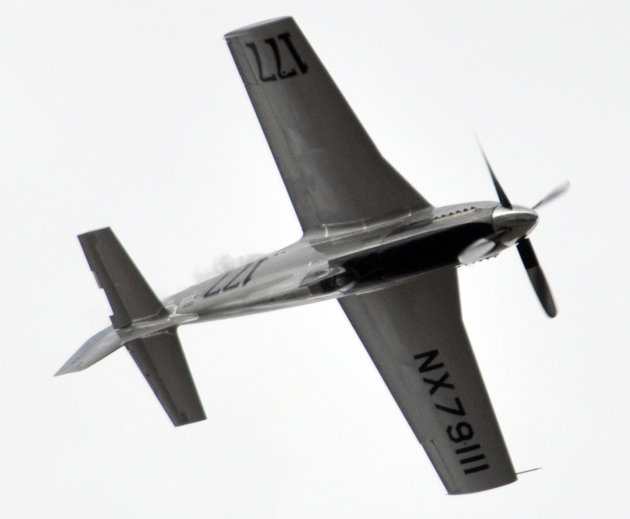
            I am speechless, except to state the tailwheel is obviously down from this angle (dark spot on the aft fuselage). As I understand it there is only a small 'up lock' on the system and high Gs will easily rip it down.


            [YOUTUBE]QNkKlVAJ2QQ[/YOUTUBE]


            And here is a picture of Bob Hoover in his plane, showing the straps and seat (I can't embed the photo)

            [ame="http://www.flickr.com/photos/powerwagon/3132524942/"]R. A. Bob Hoover | Flickr - Photo Sharing!@@AMEPARAM@@http://farm4.static.flickr.com/3227/3132524942_5d7da6ec81_m.jpg@@AMEPARAM@@3132524942@ @AMEPARAM@@5d7da6ec81[/ame]
            Last edited by NorthwestUteFan; 09-21-2011, 07:57 AM.

            Comment


            • #21
              And one more, from far in the distance:

              [YOUTUBE]TaWB_7RGTQ4[/YOUTUBE]

              Comment


              • #22
                And two more pics. In the first one notice his helmet is very far forward in the canopy, and probably resting on the dashboard. Compare with the pics above and you can see the proper location is right in the middle of the canopy. This points heavily to GLOC, or at least incapacitation due to G forces (basically his upper body was thrown forward and the dash panel got in the way - remember the 12# helmet weighs 120# at 10 Gs).


                And from another angle just before impact:

                Comment


                • #23
                  And one last post. A friend sent me this info. This is directly from the original P-51 operating manual. Notice step #5.

                  "1. EMERGENCY LANDING GEAR EXTENSION PROCEDURE

                  2. If normal extension fails, recheck landing gear warning light by retarding throttle until landing gear warning light comes on.
                  3. At an IAS of 170, put gear handle in down position and yaw plane. Recheck landing gear warning light by retarding throttle blow 20" M.P.

                  4. If the landing gear warning light is still ON, indicating gear not down and locked, pull fairing door emergency release knob and yaw the plane again to lock gear.

                  5. Then again retard throttle to check warning light. NOTE: The warning light does NOT indicate the position of the tail wheel. If there is any doubt as to whether or not the tail wheel is down, dive the airplane a short distance and pull out with enough acceleration to down the tail wheel. REMEMBER - THE ONLY CHECK AVAILABLE FOR THE MAIN GEAR IS THE WARNING LIGHT. USE IT! "

                  Comment


                  • #24
                    Originally posted by creekster View Post

                    I htink the oroingal P-51 had a manual menchanical link to the wheel (could be wrong though) and I am guessing that this highly modified plane had a hydraulic mechanism. If so, it seems unlikely that it would slam open.
                    I looked it up for you. The original retract system on the tailwheel was a combination hydraulic/spring system. Springs pull it down, and hydraulics raise it. When it gets to the top of its travel, small steel locks clamp it into place (somewhat), because the hydraulic system isn't strong enough to hold it into place (the hydraulic rams are large enough to raise it against typical forces after takeoff, but would leak down if the G load is greater than that).


                    I don't know about the design of the rams themselves but they most likely did not use o-rings (which increase the quality of the seal as pressure behind them increases). IIRC the now-standard o-ring design was invented by the Germans and we didn't know about the technology until we dissected some U-boats after the war.

                    Comment


                    • #25
                      Fascinating stuff. No question the wheel was down in that video. Sometimes accidents happen.

                      My old man was in the national guard and on duty at the SLC airport 45 or so years ago when a DC-9 crashed and burned. He had to remove bodies and look for survivors. he wouldn't step on a plane for years afterwards.
                      PLesa excuse the tpyos.

                      Comment


                      • #26
                        Originally posted by NorthwestUteFan View Post
                        I looked it up for you. The original retract system on the tailwheel was a combination hydraulic/spring system. Springs pull it down, and hydraulics raise it. When it gets to the top of its travel, small steel locks clamp it into place (somewhat), because the hydraulic system isn't strong enough to hold it into place (the hydraulic rams are large enough to raise it against typical forces after takeoff, but would leak down if the G load is greater than that).


                        I don't know about the design of the rams themselves but they most likely did not use o-rings (which increase the quality of the seal as pressure behind them increases). IIRC the now-standard o-ring design was invented by the Germans and we didn't know about the technology until we dissected some U-boats after the war.
                        According to Wikipedia (yeah, yeah, I know), O-ring was first patented in Sweden in 1896. Patented in the US in 1937. I don't doubt that the Germans could have made improvements on it though. They produced some good tech during WWI and WWII.

                        Comment


                        • #27
                          Originally posted by creekster View Post
                          Fascinating stuff. No question the wheel was down in that video. Sometimes accidents happen.

                          My old man was in the national guard and on duty at the SLC airport 45 or so years ago when a DC-9 crashed and burned. He had to remove bodies and look for survivors. he wouldn't step on a plane for years afterwards.
                          I'm reading the book, Unbroken, right now and in there it is stated that during WWII there were 52,651 stateside aircraft accidents, killing 14,903 personnel. It can be presumed that the vast majority were training flights. During a 3 month stretch in 1942, 3041 planes, more than 33 per day, met with accidents, killing 9 men per day. And in August of 1943, 590 airmen would die stateside, 19 per day.
                          "It's devastating, because we lost to a team that's not even in the Pac-12. To lose to Utah State is horrible." - John White IV

                          Comment


                          • #28
                            Originally posted by NorthwestUteFan View Post
                            It had stock wings, but he chopped five feet off each side.

                            And only the best amongst us built airplanes as young boys.
                            My brother and I had about 80 planes flying around our bedroom, mostly hanging from the ceiling.

                            There are some interesting comments on WIX.

                            "Speed around the #8 pylon - 500mph 102" MP
                            When trim tab let go 22.6 G's

                            Speed decayed to 375mph then accelerated again to 500+mph just before impact."
                            The plane was instrumented up a lot, and sent telemetry to the pit crew. Even if those G numbers are very fleeting, that's a lot of force on the plane and pilot. No wonder he was evidently thrown into the instrument panel and the tail wheel extended.

                            There was also some discussion about the Hannah and Levitz incidents.

                            Comment


                            • #29
                              It is interesting to see the instrumented G level. The attempted calculation I saw said 12 Gs.

                              At 22.6 Gs he likely weighed a ton and a half, and there is a good chance that his internal organs ruptured (trying to remember the instantly fatal G shock load from the Mythbusters episode).


                              As for kids and airplanes, here is a picture of me ~age 5. I am wearing the #55 shirt and a huge smile, holding my Cox PT-19 u-control plane:

                              Comment


                              • #30
                                Nice pic. That's really cool that the whole family was involved. How many have moms interested in rc airplanes?

                                Here's a picture I took the day I got home from my mission. It was the last frame left on the roll, and I figured it would be a good parting shot. Sorry that it's such a crappy scan of the slide. Who can name all the planes?

                                Comment

                                Working...
                                X