
Originally posted by UVACoug
View Post
-
Neither do I. I went straight from The Wire into BB, and the decidedly TV-ness of BB kind of prevented me from loving it at first. I was always comparing it to the "realism" of The Wire. But after a while I realized it was just a great TV show and not trying to be anything more. -
I don't think the show ever tried to be super realistic. Gilligan always seemed to be more about telling his story in a visually stunning and dramatically compelling way, than painting an accurate depiction of the real world of meth cooks and drug cartels. The allegory was more important than any depiction of reality. In that way, it was quite different than shows like The Wire, which, while allegorical at times, seemed to try a lot harder to replicate a version of the real world. With that said, having had my fair share of run ins with meth-heads, I don't think the stereotype is too far off from reality.Originally posted by woot View PostLeave a comment:
-
Same story for me, except I'm finding myself pretty annoyed at a lot of things. It's remarkable how annoying Skyler is. Part of it is probably the actress -- I haven't seen her in anything else to judge -- but the writing is pretty terrible on her. She's given basically nothing to do that doesn't involve lecturing Walt, and it's so over the top the intention can't be anything but to annoy the audience and make us hate her. I'm also surprised at how cartoony much of it is. The crackhouse with the fully tattooed-face guy, Jesse's meth house filled with endlessly-partying strangers, all depictions of methheads as psycho hillbillies... it all seems really on the nose. Maybe that's really how it is, but it mostly seems like a naive stereotype.Originally posted by RC Vikings View Post
I'm still mostly enjoying it, but it doesn't seem nearly as well thought out as it did my first time through. Season 5 awaits, and I'm excited to get there. Even my first time through I considered 5 a huge step up from the first 4, so I suppose my reaction so far isn't unexpected.Last edited by woot; 09-18-2014, 05:50 AM.Leave a comment:
-
My wife had never seen BB so we are watching them this fall. Second time through is almost as good as the first time.Leave a comment:
-
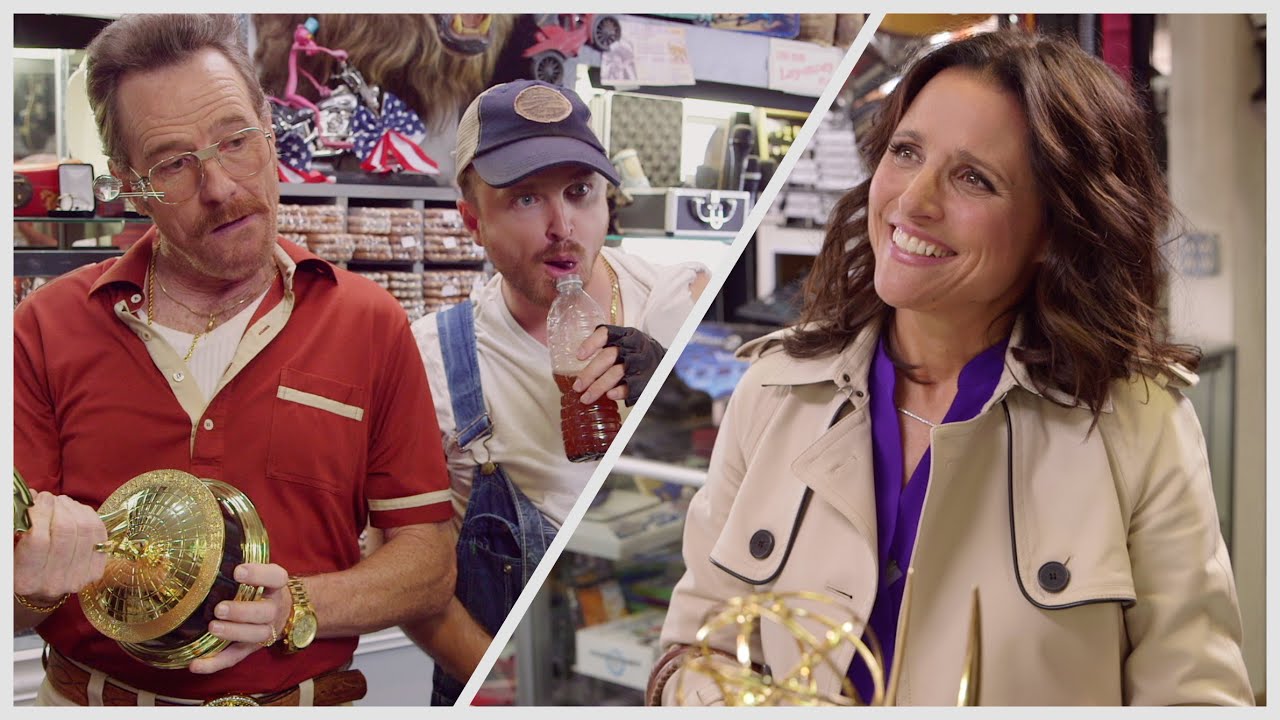
Ad for the Emmy's. Or for Audi. Or Veep. Hard to tell. I don't care.
Leave a comment:
-
For those of you whose life circumstances subject you to frequent exposure to the shitty spanish channels, here is a little treat that you probably already know about: Metastasis-- the full-on rip off of Breaking Bad. They have to have some sort of licensing deal in place, but I think this is damn amusing. The best part is that it takes place in Colombia, yet meth is it!!

This is-- shit thee I do not-- Walter Blanco, played by someone who is not Bryan Cranston and who speaks Spanish.


 Last edited by Commando; 08-11-2014, 11:59 AM.
Leave a comment:
-
Sounds like two prequals now. Better Call Saul starts in February and they are currently in production on "The Rise of Gus".Leave a comment:
-
Mike Ermentrout will be a significant presence as well. Mike was one of my favorite BB characters.Originally posted by Commando View Post
AMC has it listed on their website under "Shows". http://www.amctv.com/shows/better-call-saul
Better Call Saul is the prequel to the award-winning series Breaking Bad, set six years before Saul Goodman (Bob Odenkirk) became Walter White’s lawyer. When we meet him, the man who will become Saul Goodman is known as Jimmy McGill, a small-time lawyer searching for his destiny, and, more immediately, hustling to make ends meet. Working alongside, and often against, Jimmy is "fixer" Mike Erhmantraut (Jonathan Banks), a beloved character introduced in Breaking Bad. The series will track Jimmy's transformation into Saul Goodman, the man who puts "criminal" in "criminal lawyer."Leave a comment:
-
Here is a "tournament" Vulture.com did to find determine the best drama of the last 25 years. In the intro article they talked about TP quite a bit:Originally posted by MarkGrace View Post
All of which goes to explain the fizzy-headed clamor that greeted Twin Peaks upon its April 8, 1990 debut. Here was a show that was not only willfully, almost nonchalantly weird, but also seemingly unaware of the demands of the network drama: Characters disappeared and reappeared with little warning; seemingly benign props (logs, pies, a diner jukebox) became totems of lust or dread; and story lines took months to resolve themselves — that is, if they even resolved themselves at all. Twin Peaks was a TV show that didn’t seem to know it was a TV show, and its mere existence conveyed a strangely empowering message to TV viewers everywhere, people who’d long been content with neuron-dimming procedurals and plod-heavy soaps: You’re smarter than this.
Peaks marked an epochal moment for television, one that launched a whole new wave of inventive hour-long drama and, thanks to David Lynch's very specific vision, birthed the era of the celebrity showrunner, the Head Motherwriter in Charge whom fans worshipped as much as or more than the shows' stars, and upon whom they placed all responsibility for the show's highs and lows. And so, when Vulture set out to organize the ultimate TV-drama bracket, which begins today, we used Peaks’ 1990 debut as our entry point, making it one of just sixteen shows we’ll be putting head-to-head in the next three weeks as we work toward crowning the best drama of TV’s New Golden Age. These are shows like NYPD Blue, Buffy, The Wire, and Breaking Bad — series with neatly tangled story lines, grimly hilarious dialogue, and characters who inspire loyalty, love, and the occasional fan-fic dispatch. Shows that (enabled by the immortalization of DVDs and streaming video) are strenuously worshipped or debated years after they went off the air: In the past two weeks alone, President Obama repeated his deep conviction that Omar is The Wire's greatest character, while the AV Club heretically posted that the HBO model has damaged TV by making dramas more about the overall arc than individual episodes.
The first round actually pitted TP against Breaking Bad.
The creators of both Twin Peaks and Breaking Bad are masters at defying convention. Here we have two shows that refuse to be simply comedies or dramas. These are true, dark dramedies, their central mysteries sprinkled with bleak (but always truthful) laughs. We witnessed Cranston’s comedy chops as the dad on Malcolm in the Middle, and he’s just as funny playing Walt. We laugh with and at him, especially when he’s at the end of his rope. The comedy of Breaking Bad stems from the ridiculous things we humans say and do when we’re at our breaking points — such as when Walt, locked out of his house by his wife, Skyler (Anna Gunn), reacts by throwing a pizza onto the roof. (Later on, he wakes up hung-over and alone, and proceeds to grabs his crotch and yell, “I’ve got your restraining order right here!” while standing alone in his underwear.)
Twin Peaks, on the other hand, utilizes the comedy of the totally, totally absurd — not out-of-this-world ridiculous, but everyday moments taken to a new place: The elaborate doughnut arrangements constructed by Lucy, the well-intentioned police secretary; Cooper’s obsessive recordings to his assistant, Diane; and the way reclusive housewife Nadine obsesses over her silent drapes.
In addition to being unexpectedly hilarious, there’s another compelling reason why we love these shows: The creators think we are geniuses. They trust us. With Twin Peaks, Lynch relies heavily on subconscious images and motifs. He trusts us to either recognize these from long-gone episodes, or — if we don’t — still garner some meaning from what we are watching, nonsensical as a scene may seem. A loyal viewer will watch the show come full circle, though it’s never quite spelled out. Intellectually delicious.
Meanwhile, back on Bad, Gilligan trusts that we’ll stick by Walt no matter what he does. He’s created a show focusing on a main character who’s constantly changing, as opposed to the conventional TV protagonist who will fundamentally stay the same from season to season. Walter White is a good guy who becomes the bad guy — and then becomes an even worse guy. As we watch him commit his first murder, strangling a meth dealer to death with a bike lock out of self-defense, we understand why he does it. Gilligan trusts us as empathetic human beings, people who understand that things aren’t always so black-and-white.The writer predictably (and correctly) gave the win to BB.One final comparison point between those two shows: MURDER. Or, more specifically, how they treat death. When watching Law & Order or Body of Proof, it’s somehow simple to separate yourself from a scene of ghastly demise. You’re safe on your futon, the horror trapped safely within the confines of your screen, with only the possibility that it will visit you later in your dreams. But both Twin Peaks and Breaking Bad make these scenes inescapable and somehow shed new light on something we’ve seen a hundred times before. Twin Peaks makes death beautiful; Breaking Bad, specific and painfully real. And its protagonists respond accordingly.Leave a comment:


Leave a comment: