
In my more believing days, I used to think this idea of light being everywhere at once was an obvious allusion to God, if physicists would only look at their own equations with an eye of faith--after all, this is how we explain that God (light) is omnipresent. Like many others who attempt to popularize/religionize scientific concepts (clack, I'm staring at you.  ), I had it wrong.
I still think it's fun and kind of mind-blowing to think about.
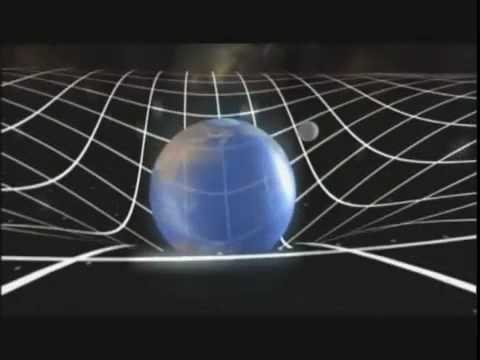
EDIT: Just watched the Nova video that Uncle Ted linked. The description of gravity as a curve in space-time that I referred to above comes at about 7:00--it's good. Also, it shows exactly the problem with my light as God theory from my undergrad days, and what Ted didn't read in my initial post. The thought of light from its own inertial perspective is mind-blowing, but sort of meaningless because none of us are in that frame. And of course, when we make the claim that God is omnipresent, we're making it from our frame, one in which light (and information and gravitational waves, aka "event horizon") has a meaningful speed and lengths, distances, times, and masses matter. In other words, light (and God) is not omnipresent in our frame.
), I had it wrong.I still think it's fun and kind of mind-blowing to think about.
EDIT: Just watched the Nova video that Uncle Ted linked. The description of gravity as a curve in space-time that I referred to above comes at about 7:00--it's good. Also, it shows exactly the problem with my light as God theory from my undergrad days, and what Ted didn't read in my initial post
. The thought of light from its own inertial perspective is mind-blowing, but sort of meaningless because none of us are in that frame. And of course, when we make the claim that God is omnipresent, we're making it from our frame, one in which light (and information and gravitational waves, aka "event horizon") has a meaningful speed and lengths, distances, times, and masses matter. In other words, light (and God) is not omnipresent in our frame.






Comment