-
I own both volumes and regularly consult them in preparation for SS lessons. They are organized so well that they can easily be used in real time to shoot down insanity if you have the kindle version. -
I posted this in another thread a while back, but after hearing an interview with the author on Mormon Stories, one thing I appreciated was the flexibility of the LDS church and its doctrine--something that frustrates a lot of anti-Mormons. He mentioned in the interview that BRM et al were responding to a dynamic within the church and its membership that was seeking specific hard answers to questions--an approach he thought was a mistake--and that the church seems to be moving away from that now, but is somewhat a slave to its past. He pointed to Elder Uchdorf and Elder Holland (not sure of his logic on this one, but ok...) as leaders of this new direction. There are very few doctrines that haven't significantly changed since their inception, and by extension, will likely change again with time. If you don't like an idea in the current church, that's ok, because there's a decent chance that in 100 years, that belief will look very different. That kind of thinking is very reassuring to some of us, and I think/hope this book would be a useful reference to support it.
Oh, and Borg--he's a BYU professor and active Mormon.Leave a comment:
-
What I like about the author is that he delivers crushing blows to some of my most beloved LDS beliefs* in a matter-of-fact voice. No nasty atheist glorying as another latter-day sentiment bites the dust. No apologetic compulsion to explain it all away. Just a businesslike lets-clear-all-the-cobwebs-away so we can really get down to brass tacks about what we believe.
*I've posted about how I was crushed, crushed I tell you, to find out Isaiah's "Line upon line, precept on precept..." was a mistranslation.Leave a comment:
-
Looks interesting. Written by a prof of manufacturing engineering? Hmmm....
So, does this book have any bias towards the Church pro/con in the doctrines?...or is it more of how teaching/principles have changed over time? What?
I might have to check this out.Leave a comment:
-
Did Christians start saying this before or after Christianity actually did crush the Roman Empire?Originally posted by Jeff Lebowski View PostLeave a comment:
-
I've been meaning to read this for a long time. This should be an interesting thread.Leave a comment:
-
Not sure I agree that this is the median view of the academy. Of course, deciding what is the median view of scholars can be tricky and I obviously I am an outsider to that academic community so I may misestimate the median view. I think I would summarize the consensus more like the following: I think most scholars today date the apocalyptic sections (chapters 7-12) and the final form of the book to about 167-164 BCE because they feel the visions are most accurate and detailed when writing about the crisis caused by the division of Alexander the Great’s empire. On the other hand scholars think that the writing is less accurate when describing 6th century BCE. Also, scholars tend to suggest the court tales (chapters 1-6) may date to an earlier period in terms of authorship.Originally posted by Jeff Lebowski View Post
Personally, I think it is a bit of aggressive to place Daniel 2 in 167-164 BCE but I also think that there is a non-trivial probability the core of is from that time period. And it certainly it wouldn't surprise me if there was some editing/redaction in that time period of Daniel 2. And I certainly doubt 6th century dating.Last edited by pelagius; 03-12-2013, 01:01 PM.Leave a comment:
-
This is going to be my next purchase when I'm done with The God Who Weeps and Biocentrism (I'm only a couple of chapters in, but its really interesting).Leave a comment:
-
This first item could be covered in the "I learned at Church today" thread or the SS lesson thread, but I will put it here. Last Sunday our Gospel Doctrine lesson was on the Restoration and we spent a fair amount of time discussing the "Stone cut without hands" scripture in Daniel 2:
In this dream, Daniel was interpreting a dream by king Nebuchadnezzar. The final kingdom that is the "Stone cut without hands" was interpreted by JS to the the restored LDS church and he referenced himself as the stone, hence the "Rough Stone Rolling" title of Richard Bushman's recent bio on JS.28 But there is a God in heaven that revealeth secrets, and maketh known to the king Nebuchadnezzar what shall be in the latter days. Thy dream, and the visions of thy head upon thy bed, are these;
29 As for thee, O king, thy thoughts came into thy mind upon thy bed, what should come to pass hereafter: and he that revealethsecrets maketh known to thee what shall come to pass.
30 But as for me, this secret is not revealed to me for anywisdom that I have more than any living, but for their sakes that shall make known the interpretation to the king, and that thou mightest know the thoughts of thy heart.
31 ¶Thou, O king, sawest, and behold a great image. This great image, whose brightness was excellent, stood before thee; andthe form thereof was terrible.
32 This image’s head was of fine gold, his breast and his arms of silver, his belly and his thighs of brass,
33 His legs of iron, his feet part of iron and part of clay.
34 Thou sawest till that a stone was cut out without hands, which smote the image upon his feet that were of iron and clay, and brake them to pieces.
35 Then was the iron, the clay, the brass, the silver, and the gold, broken to pieces together, and became like the chaff of the summer threshingfloors; and the wind carried them away, that noplace was found for them: and the stone that smote the image became a great mountain, and filled the whole earth.
36 ¶This is the dream; and we will tell the interpretation thereof before the king.
37 Thou, O king, art a king of kings: for the God of heaven hath given thee a kingdom, power, and strength, and glory.
38 And wheresoever the children of men dwell, the beasts of the field and the fowls of the heaven hath he given into thine hand, and hath made thee ruler over them all. Thou art this head of gold.
39 And after thee shall arise another kingdom inferior to thee, and another third kingdom of brass, which shall bear rule over all the earth.
40 And the fourth kingdom shall be strong as iron: forasmuch as iron breaketh in pieces and subdueth all things: and as iron that breaketh all these, shall it break in pieces and bruise.
41 And whereas thou sawest the feet and toes, part of potters’ clay, and part of iron, the kingdom shall be divided; but there shall be in it of the strength of the iron, forasmuch as thou sawest the iron mixed with miry clay.
42 And as the toes of the feet were part of iron, and part of clay,so the kingdom shall be partly strong, and partly broken.
43 And whereas thou sawest iron mixed with miry clay, they shall mingle themselves with the seed of men: but they shall not cleave one to another, even as iron is not mixed with clay.
44 And in the days of these kings shall the God of heaven set up akingdom, which shall never be destroyed: and the kingdom shall not be left to other people, but it shall break in pieces andconsume all these kingdoms, and it shall stand for ever.
45 Forasmuch as thou sawest that the stone was cut out of the mountain without hands, and that it brake in pieces the iron, the brass, the clay, the silver, and the gold; the great God hath madeknown to the king what shall come to pass hereafter: and the dream is certain, and the interpretation thereof sure.
Harrell provides a fascinating account of how this scripture has been interpreted over time. It always puzzled me as I read this chapter what the earlier kingdoms represent (iron, clay, brass, silver, and gold) because they seem to reference a specific set of kingdoms that the reader would understand. Biblical scholars say that the Book of Daniel was actually written in about 165 BC, not 600 BC, and that Daniel was actually a fictional person and the name Daniel was kind of like a pen name for several later authors. They also say that in the context of 165 BC, the various kingdoms referenced are specific kingdoms that can be identified (Babylon, Media, Persia, Greece). Note also that it says "… in the days of these kings.." implying that the fulfillment would be immediate, not 2000 years in the future. They say that the prophecy was given during the Maccabean Revolt and was meant to give comfort that they would be victorious and a new kingdom of Israel would arise (unfortunately didn't happen).
Interestingly, the kingdom envisioned by Daniel has been most commonly interpreted by Christian commentators and believers to be the Kingdom of God ushered in by Jesus Christ and the kingdom being crushed was the Roman empire (I like this interpretation). Also, just after the US revolution, many Americans believed that the birth of the United States as a nation was a fulfillment of this prophecy. And of course, JS applied it to the restoration also (D&C 65:2-6).Last edited by Jeff Lebowski; 03-12-2013, 11:58 AM.Leave a comment:
-
This Is My Doctrine: The Development of Mormon Theology
I have been talking about this book for a few months now:
This Is My Doctrine: The Development of Mormon Theology
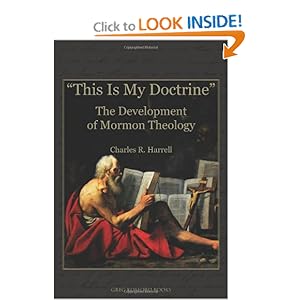
The author is Charles Harrell, a BYU prof. It is a two-volume publication covering all of the core LDS doctrines and beliefs and it systematically traces the development (and in most cases, evolution) of each doctrine, both in terms of Christianity in general and in terms of LDS history and scripture.
I am slowly working my way through Volume 2. I am going slowly because there is so much to absorb. It is already one of my top 5 all-time favorite LDS books. I was chatting about the book with Solon the other day via PM and we agreed that it deserves a dedicated thread. So here goes.
(post soon to follow)


Leave a comment: