
 Tweet
Tweet
Tonight We Die as Men: The Untold Story of Third Batallion 506th Parachute Infantry Regiment..... I'm 100 pages in. I now understand why my professors hated block quotes. Gardner gives tons of facts and anecdotes, but he's not a gifted writer. That said, I haven't gotten to D-Day yet, so maybe once we get out of training, it will hold my interest.
-
Jesus wants me for a sunbeam.
"Cog dis is a bitch." -James Patterson -
Meant to post about this when it happened, but didn't get around to it. Thankfully, it's more interesting now that a rebuttal of sorts has been published in the NY Times.
I was watching the live stream of the National Book Award ceremony, and after author Jaqueline Woodson's "Brown Girl Dreaming" won for best Children's Book and she had left the podium after her acceptance speech, the emcee, Daniel Handler (Lemony Snicket) took the mic and made the following joke:
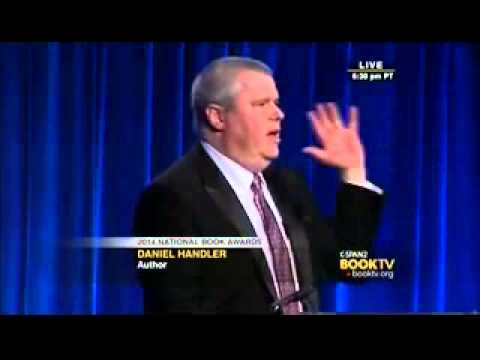
I couldn't believe that anyone would think that comment was ok, and was shocked that nothing further was said about it while I was watching. Handler was clearly a guy who thought he had some kind of "pass" to make a comment like that, but I was happy to see that no such pass existed, (though I do believe he got much gentler treatment than many would have). A couple of days later Woodson responded via an essay in the NY Times:
http://www.nytimes.com/2014/11/29/op...joke.html?_r=0
As I walked away from the stage to a standing ovation after my acceptance speech, it was the last place in the world I thought I’d hear the watermelon joke — directed by the M.C., Daniel Handler, at me. “Jackie’s allergic to watermelon,” he said. “Just let that sink in your mind.” Daniel and I have been friends for years. Last summer, at his home on Cape Cod, he served watermelon soup and I let him know I was allergic to the fruit. I was astonished when he brought this up before the National Book Award audience — in the form of a wink-nudge joke about being black.
In a few short words, the audience and I were asked to take a step back from everything I’ve ever written, a step back from the power and meaning of the National Book Award, lest we forget, lest I forget, where I came from. By making light of that deep and troubled history, he showed that he believed we were at a point where we could laugh about it all. His historical context, unlike my own, came from a place of ignorance.
“Brown Girl Dreaming” is the story of my family, moving from slavery through Reconstruction, Jim Crow and the civil rights movement, and ends with me as a child of the ’70s. It is steeped in the history of not only my family but of America. As African-Americans, we were given this history daily as weapons against our stories’ being erased in the world or, even worse, delivered to us offhandedly in the form of humorLast edited by SteelBlue; 12-01-2014, 01:03 PM.Comment
-
I'd be curious to know how much of his story is true and how much of it is fabricated for impact. That is, back when she told him she was allergic to watermelon, did he really say she should write a book about it? Did they engage in the banter he describes? If so, and she wasn't offended then, why should she be offended by the story being shared in public? Assuming the banter actually did occur, I suspect that she wasn't really offended by his comments, but that she felt some sort of PC obligation to respond, lest she be labeled the black writer who writes books about the plight of black Americans but isn't bothered by playful banter about racial stereotypes.Originally posted by SteelBlue View Post
I suppose the conversation could have ended at "I'm allergic to watermelon" and the rest of the story is fabricated and part of the joke. But that doesn't seem like a natural ending point for a conversation about a fairly unusual allergy.Prepare to put mustard on those words, for you will soon be consuming them, along with this slice of humble pie that comes direct from the oven of shame set at gas mark “egg on your face”! -- Moss
There's three rules that I live by: never get less than twelve hours sleep; never play cards with a guy who's got the same first name as a city; and never go near a lady's got a tattoo of a dagger on her body. Now you stick to that, everything else is cream cheese. --Coach FinstockComment
-
I see your point, but I still can't imagine the appropriate place to tell that story. I find the social aspects of his faux pas kind of fascinating. Without a doubt, he believed he had those endorsements he was joking about, but clearly he was wrong, even in the instance of his friend, perhaps especially in the instance of his friend.Originally posted by Donuthole View PostComment
-
The Martian by Andy Weir. It's really good. It's not a character study, but I liked that aspect. Not every story needs to be about the characters. It'll be interesting to see how Ridley Scott handles the movie. If it's done right, it could be as good as Apollo 13.Comment
-
Just finished, "My Struggle: Book 1" by Karl Ove Knausgaard. I'm a bit late to this party, as I think book 1 has been available in English for over a year now. It was a satisfying reading experience, but definitely not for everyone. I've been somewhat obsessed lately with the idea that in life, much of what is truly meaningful and important is hidden among what we normally would call day to day tedium. In this book, and I assume the whole series, Knausgaard tells his own story, riding a line between autobiography and fiction (it is officially classified as fiction but is apparently true enough that some in his family are not speaking to him), in the minutest of detail. I felt like he was trying to demonstrate through this style something akin to the point I made above, and for me, it worked. He uses a death to really bring home this message.
This style isn't for everyone, and if you're not seeing or buying the concept, then you're going to feel like you've just read 500 pages of banality. But, if you're in the mood for some reflection on life and meaning then this will likely be rewarding. There were moments of brilliance frequent enough to leave me wanting more and so I'll invest my time into at least Book 2.
The NYT review:
http://www.nytimes.com/2014/05/22/bo...ment.html?_r=0
51jLlF0aN6L._SY344_BO1,204,203,200_.jpgLast edited by SteelBlue; 12-03-2014, 12:42 PM.Comment
-
Isn't this a 7 part series? I've wanted to check this out, but it feels a bit daunting.Originally posted by SteelBlue View PostComment
-
I think 6 parts at about 500 pages each. I've only read Book 1, and it holds up just fine as a stand alone book. Not sure if that would be true of the others. So, yeah, it's lengthy and polarizing. My guess is that you'd like it, AJ.Originally posted by Applejack View PostComment
-
It's on my list, but I need to read some Stegner first to reconnect with my Utah roots.Originally posted by SteelBlue View PostComment
-
Anybody ever read low brow stuff.
I found a really, off beat work named,"This Means War, a Donovan Creed Novel (12)".
It is a about a billionaire who formerly worked for Homeland Security, who thinks up potential attacks to test Homeland Security, and doubles part time as an assassin for the mob, to keep his skills up. It is a guilty pleasure.
The rest of you seem intent on reading intellectual works of art. Kudos to Steel Blue."Guitar groups are on their way out, Mr Epstein."
Upon rejecting the Beatles, Dick Rowe told Brian Epstein of the January 1, 1962 audition for Decca, which signed Brian Poole and the Tremeloes instead.Comment
-
Euphoria, by Lily King is showing up on almost every year end/best of list I see. I hadn't heard of it until last week. Has anyone here read it?Comment
-
Sounds sort of like Proust. Which means I have mixed feelings about it.Originally posted by SteelBlue View PostPLesa excuse the tpyos.Comment
-
It is frequently described as Proustian.Originally posted by creekster View Post
BTW, I'm still smiling about your building a bigger rabbit story.Comment
-
Empires of Light by Jill Jonnes. You'd think it was a biography of Thomas Kinkade. I WISH! No, it is a brief chronicle of the late 19th century race to electrify the world (and profit thereby). Deals mainly with Edison, Tesla, and Westinghouse, as the subtitles says. Not extremely in depth but hits the high points and I'm enjoying it and learning some new stuff about these guys. Jill also wrote Conquering Gotham about the Pennsylvania RR's building of Penn Station and the Hudson/E. River Tunnels, which I enjoyed immensely. Engineer nerd.Comment
-
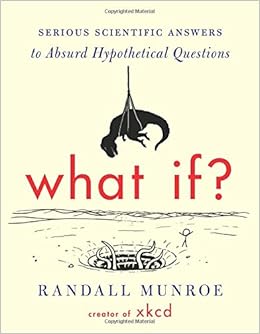
got this yesterday at the work gift exchange. Twas on my book list already.
20 pages in last night, did not disapoint.I intend to live forever.
So far, so good.
--Steven WrightComment


Comment